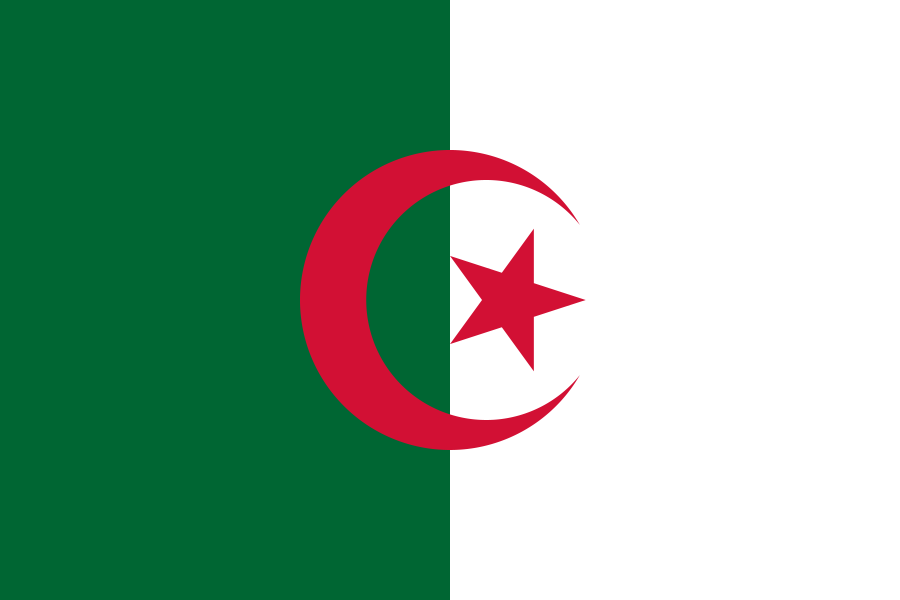
 Algeria


Quick answerAlgeria is a country in Northern Africa, with a population of 47,435,312 (2025). Its capital is Algiers, its official languages are Arabic and Amazigh, and its currency is the Algerian dinar (DZD). It covers 2,381,741 square kilometres (919,595 square miles), and its time zone is Africa/Algiers.
Algeria is the largest country in Africa, home to about 47 million people. Its capital is Algiers, its official languages are Arabic and Amazigh, and its currency is the Algerian dinar.
Key facts
| Capital | Algiers |
|---|---|
| Population | 47,435,312 (2025) · 47.4 million |
| Population density | 19.9 people per km² (land area) |
| Area | 2,381,741 km² (919,595 sq mi) total · 2,381,741 km² (919,595 sq mi) land |
| Official languages | Arabic (official), Amazigh (official) |
| Currency | Algerian dinar (DZD, د.ج) |
| Time zone | Africa/Algiers |
| Government | Unitary semi-presidential republic |
| Coastline | 998 km |
| Highest point | Mount Tahat, 2,908 m |
| Life expectancy | 76.5 years (2024) |
| Calling code | +213 |
| Driving side | Right |
| Internet domain | .dz |
Overview
Algeria covers 2,381,741 square kilometres in North Africa, making it the largest country in Africa and the tenth-largest in the world. It stretches from the Mediterranean Sea in the north, past the coastal Atlas Mountains and the high plateaus, deep into the Sahara, which covers most of the country. The highest point is Mount Tahat, at 2,908 metres in the Hoggar Mountains of the southern Sahara, and the country has 998 kilometres of Mediterranean coastline.
About 47.4 million people lived in Algeria in 2025, according to the World Bank, making it the tenth-most populous country in Africa. About 76 per cent of Algerians live in towns and cities, almost all of them in the fertile coastal north, while the Sahara is nearly empty. Arabic and Amazigh are the official languages, French is widely used, and life expectancy at birth reached 76.5 years in 2024, among the highest in Africa. The median age is about 29.
Algeria's history runs from the ancient Berber kingdom of Numidia, whose king Masinissa unified the region in the 2nd century BC, through Roman, Vandal and Byzantine rule, to the Arab conquest in the 7th century and the Ottoman Regency of Algiers from 1516. France invaded in 1830 and ruled for 132 years, until the Algerian War of 1954 to 1962 won independence in 1962. The country then descended into a bloody civil war from 1992 to 2002, remaining in an official state of emergency until the protests of the Arab Spring in 2010 to 2012.
Algeria has the third-largest economy in Africa, built on oil and natural gas: its petroleum reserves are the 16th-largest in the world and its natural gas reserves the 9th-largest. It also has the highest Human Development Index in continental Africa. Its heritage includes the rock art of Tassili n'Ajjer, the Roman ruins of Timgad and Djémila, and the Casbah of Algiers, all UNESCO World Heritage sites. Algerian culture blends Arab and Amazigh traditions, in its music, food and crafts, from raï to couscous.
Notable facts
- Algeria is the largest country in Africa and the tenth-largest in the world, covering 2,381,741 square kilometres.
- The Sahara covers most of Algeria, while almost everyone lives in the fertile, mountainous north along the Mediterranean coast.
- Algeria's petroleum reserves are the 16th-largest in the world and its natural gas reserves the 9th-largest.
- Algeria has the highest Human Development Index in continental Africa.
- Life expectancy at birth in Algeria was 76.5 years in 2024, according to the World Bank.
How Algeria compares
Comparison table — Algeria next to 3 similar countries (neighbours first, then the same subregion).
| Country | Population | Area | Density | Capital |
|---|---|---|---|---|
| Algeria ★ | 47,435,312 (2025) | 2,381,741 km² | 19.9 people per km² | Algiers |
| Egypt | 120,101,175 (2026) | 1,010,408 km² | 120.7 people per km² | Cairo |
| Australia | 27,801,023 (2025) | 7,692,024 km² | 3.6 people per km² | Canberra |
| Bangladesh | 179,300,000 (2026) | 148,460 km² | 1377.4 people per km² | Dhaka |
Cities in Algeria
- Algiers Known for Casbah of Algiers
- Oran Known for Fort of Santa Cruz
- Annaba Known for Basilica of St. Augustine
- Constantine Known for City of Bridges
Frequently asked questions
What is the capital of Algeria?
The capital of Algeria is Algiers, on the Mediterranean coast in the north of the country. It is also the largest city, with about 4.3 million people (2025). Algiers is known as the White City for its whitewashed buildings, and its old Casbah is a UNESCO World Heritage site.
What is the population of Algeria?
Algeria had a population of about 47.4 million in 2025, according to the World Bank, making it the tenth-most populous country in Africa. About 76 per cent of Algerians live in towns and cities, most of them in the fertile coastal north, while the Sahara covers most of the country's land.
What language is spoken in Algeria?
Algeria has two official languages: Arabic and Amazigh, the language of the Indigenous Berber people. Most Algerians speak Algerian Arabic in daily life, and French is widely used in business, education and the media, a legacy of 132 years of French rule that ended in 1962.
What currency is used in Algeria?
Algeria uses the Algerian dinar (DZD, symbol د.ج). Banknotes are the usual form of the currency, and cash is still common in markets and small shops. Cards are accepted in hotels and larger stores in the cities, but visitors should carry cash, especially when travelling outside Algiers and Oran.
Where is Algeria?
Algeria is in North Africa, on the Mediterranean Sea, between Morocco and Tunisia. It is the largest country in Africa, covering 2,381,741 square kilometres. It borders Libya, Niger, Mali, Mauritania and Morocco, and the Sahara desert covers most of the country south of the coastal Atlas Mountains.
What time zone is Algeria in?
Algeria uses a single time zone, Central European Time (UTC+1), across the whole country. The IANA time zone name is Africa/Algiers. There is no daylight saving time, so the clocks stay the same all year, from the Mediterranean coast in the north to the Sahara in the south.
Quick quiz
Three questions from the facts on this page. No sign-up, no score is saved.
Keep exploring
- Algiers — capital of Algeria
- Oran — city in Algeria
- Annaba — city in Algeria
- Constantine — city in Algeria
- Libya — neighbouring country (page coming soon)
- Mali — neighbouring country (page coming soon)
- Mauritania — neighbouring country (page coming soon)
- Morocco — neighbouring country (page coming soon)
- Niger — neighbouring country (page coming soon)
- Tunisia — neighbouring country (page coming soon)
- Egypt — another country in Northern Africa
- All countries — the full list
Sources & last updated
- Wikipedia — Algeria
- World Bank, World Development Indicators
- world-countries (mledoze/countries: area, borders, capital, languages, currency, demonym, calling code, landlocked, coordinates, region, tld)
- Wikipedia — List of countries and dependencies by length of coastline
- Office National des Statistiques (ONS), via French Wikipedia — Démographie de l'Algérie
Last updated: . Figures are shown with their year; where sources disagree, the value is left out rather than estimated.