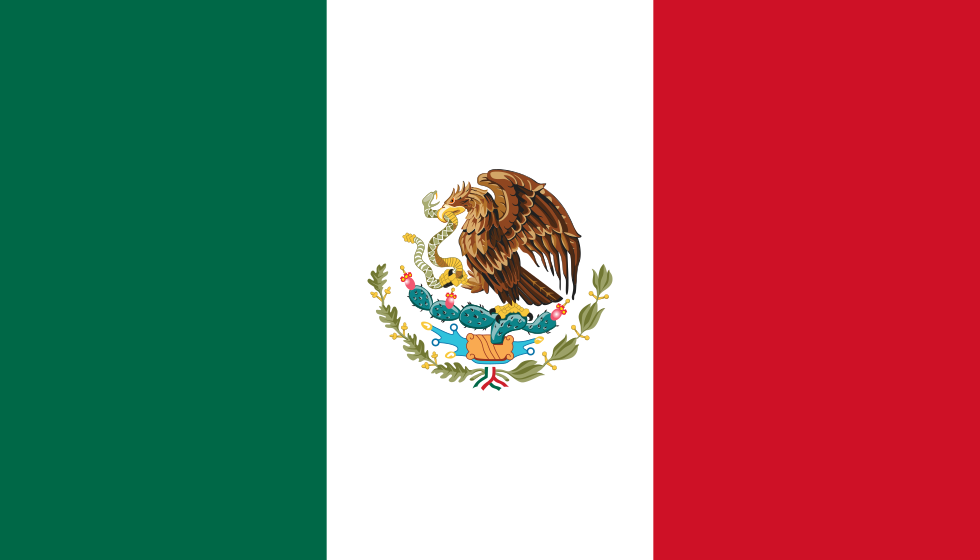
 Mexico


Quick answerMexico is a country in North America, with a population of 130,911,314 (2025). Its capital is Mexico City, its official language is Spanish, and its currency is the Mexican peso (MXN). It covers 1,964,375 square kilometres (758,449 square miles), and its time zone is America/Tijuana.
Mexico is the tenth most populous country in the world, home to about 130.9 million people. Its capital is Mexico City, its official language is Spanish, and its currency is the Mexican peso.
Key facts
| Capital | Mexico City |
|---|---|
| Population | 130,911,314 (2025) · 130.9 million |
| Population density | 67.3 people per km² (land area) |
| Area | 1,964,375 km² (758,449 sq mi) total · 1,943,945 km² (750,561 sq mi) land |
| Official language | Spanish (official) |
| Currency | Mexican peso (MXN, $) |
| Time zones | America/Tijuana, America/Mazatlan, America/Monterrey, America/Mexico_City, America/Cancun |
| Government | Federal presidential republic |
| Coastline | 9,330 km |
| Highest point | Pico de Orizaba, 5,636 m |
| Life expectancy | 75.3 years (2024) |
| Calling code | +52 |
| Driving side | Right |
| Internet domain | .mx |
Overview
Mexico sits between the United States to the north and Guatemala and Belize to the south-east, with long coastlines on the Pacific Ocean and the Gulf of Mexico. It covers 1,964,375 square kilometres, making it one of the largest countries in the Americas, and its landscapes run from northern deserts and the Sierra Madre mountains to tropical forests in the south and the Yucatan Peninsula. Pico de Orizaba, a dormant volcano, rises to 5,636 metres, the highest point in the country and the third highest in North America. The Baja California Peninsula stretches south along the Pacific coast, and Mexico also includes islands in both oceans.
About 130.9 million people lived in Mexico in 2025, according to INEGI, the national statistics institute, making it the tenth most populous country in the world and the most populous Spanish-speaking country. About 79.8 per cent of the population was urban in 2024, according to the World Bank. Mexico City, the capital, anchors a metropolitan area of about 21.8 million people, while Guadalajara and Monterrey each anchor metropolitan areas of more than five million. Spanish is the official language, and 68 indigenous languages are also recognised as co-official. Life expectancy at birth was 75.3 years in 2024.
Mexico is a federal presidential republic of 31 states plus Mexico City. Its history runs from the Olmec, Maya and Aztec civilisations through three centuries of Spanish rule to independence in 1821 and revolution in 1910. Mexico has more UNESCO World Heritage sites than any other country in the Americas, from the pyramids of Teotihuacan and Chichen Itza to the historic centres of Mexico City and Puebla. Its economy is one of the largest in Latin America, built on manufacturing, oil, agriculture and tourism, and Mexican food, music and festivals, from mariachi to the Day of the Dead, are known around the world.
Notable facts
- Mexico's population was 130,911,314 in 2025, according to INEGI, making it the tenth most populous country in the world.
- Pico de Orizaba, at 5,636 metres, is the highest point in Mexico and the third highest peak in North America.
- Mexico has more UNESCO World Heritage sites than any other country in the Americas, including Chichen Itza and Teotihuacan.
- Spanish is the official language of Mexico, and 68 indigenous languages are also recognised as co-official.
- Life expectancy at birth in Mexico was 75.3 years in 2024, according to the World Bank.
How Mexico compares
Comparison table — Mexico next to 3 similar countries (neighbours first, then the same subregion).
| Country | Population | Area | Density | Capital |
|---|---|---|---|---|
| Mexico ★ | 130,911,314 (2025) | 1,964,375 km² | 67.3 people per km² | Mexico City |
| United States | 341,784,857 (2025) | 9,833,520 km² | 37.4 people per km² | Washington, D.C. |
| Canada | 41,798,407 (2026) | 9,984,670 km² | 4.6 people per km² | Ottawa |
| Australia | 27,801,023 (2025) | 7,692,024 km² | 3.6 people per km² | Canberra |
Cities in Mexico
- Mexico City 9,209,944 people (2020) · Capital Known for Zócalo
- Puebla 1,542,232 people (2020) Known for Historic centre (UNESCO)
- Guadalajara 1,385,629 people (2020) Known for Mariachi music
- Monterrey 1,142,952 people (2020) Known for Cerro de la Silla
Frequently asked questions
What is the capital of Mexico?
The capital of Mexico is Mexico City. It is also the country's largest city, with about 9.2 million people inside the city limits (2020 census) and about 21.8 million in the wider metropolitan area. The city stands on the site of the Aztec capital Tenochtitlan, at 2,240 metres above sea level, and is home to the Zocalo and Chapultepec Park.
What is the population of Mexico?
Mexico had a population of 130,911,314 in 2025, according to INEGI, the national statistics institute. That makes it the tenth most populous country in the world and the most populous Spanish-speaking country. Most Mexicans live in cities, with the largest urban areas around Mexico City, Guadalajara and Monterrey.
What language is spoken in Mexico?
Spanish is the official language of Mexico and is spoken by almost everyone. The constitution also recognises 68 indigenous languages as co-official, including Nahuatl, Maya, Mixtec and Zapotec. English is widely understood in tourist areas and along the United States border, but Spanish is the language of government, schools and everyday life.
What currency is used in Mexico?
Mexico uses the Mexican peso (MXN, symbol $). Coins and banknotes come in a wide range of values, and cash is still common in markets and small towns. Cards are widely accepted in cities, hotels and larger shops, and ATMs are easy to find. Prices in tourist areas are sometimes also shown in US dollars.
Where is Mexico?
Mexico is in North America, between the United States to the north and Guatemala and Belize to the south-east. It has coastlines on the Pacific Ocean to the west and the Gulf of Mexico and the Caribbean Sea to the east. The country also includes the Baja California Peninsula and the Yucatan Peninsula.
What time zone is Mexico in?
Mexico spans several time zones, from UTC-8 in Baja California to UTC-5 in Quintana Roo. Most of the country, including Mexico City, Guadalajara and Monterrey, uses Central Time (UTC-6). Mexico abolished daylight saving time in 2022, except in a few towns along the United States border.
Quick quiz
Three questions from the facts on this page. No sign-up, no score is saved.
Keep exploring
- Mexico City — capital of Mexico
- Puebla — city in Mexico
- Guadalajara — city in Mexico
- Monterrey — city in Mexico
- Belize — neighbouring country (page coming soon)
- Guatemala — neighbouring country (page coming soon)
- United States — neighbouring country
- Canada — another country in North America
- All countries — the full list
Sources & last updated
- Wikipedia — Mexico
- INEGI (National Institute of Statistics and Geography), via Wikipedia
- World Bank, World Development Indicators
- CIA World Factbook — Mexico
- mledoze/countries (skeleton: area, borders, currencies, languages, latlng)
Last updated: . Figures are shown with their year; where sources disagree, the value is left out rather than estimated.