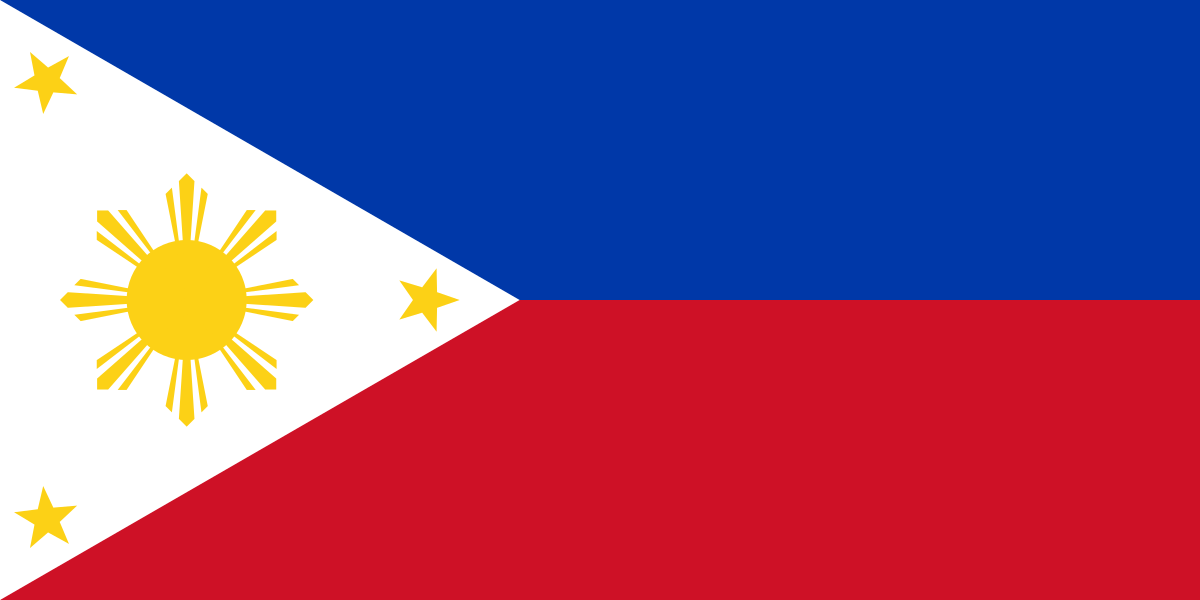
 Philippines


Quick answerPhilippines is a country in South-Eastern Asia, with a population of 114,849,400 (2026). Its capital is Manila, its official languages are Filipino and English, and its currency is the Philippine peso (PHP). It covers 300,000 square kilometres (115,831 square miles), and its time zone is Asia/Manila.
The Philippines is an archipelagic country in South-East Asia, home to about 115 million people. Its capital is Manila, its largest city is Quezon City, and its official languages are Filipino and English.
Key facts
| Capital | Manila |
|---|---|
| Population | 114,849,400 (2026) · 114.8 million |
| Population density | 385.2 people per km² (land area) |
| Area | 300,000 km² (115,831 sq mi) total · 298,170 km² (115,124 sq mi) land |
| Official languages | Filipino (official), English (official) |
| Currency | Philippine peso (PHP, ₱) |
| Time zone | Asia/Manila |
| Government | Unitary presidential republic |
| Coastline | 36,289 km |
| Highest point | Mount Apo, 2,954 m |
| Life expectancy | 69.8 years (2023) |
| Calling code | +63 |
| Driving side | Right |
| Internet domain | .ph |
Overview
The Philippines is an archipelagic country in South-East Asia, in the western Pacific Ocean, made up of about 7,641 islands with a total area of about 300,000 square kilometres. The islands fall into three main groups, from north to south: Luzon, the Visayas and Mindanao. The country has 36,289 kilometres of coastline, one of the longest in the world, and it has no land borders at all, only sea borders with Taiwan, Indonesia, Malaysia, Vietnam, China, Japan and Palau. Its highest point is Mount Apo, at 2,954 metres on Mindanao.
About 114.8 million people lived in the Philippines in 2026, making it the thirteenth-most populous country in the world. Around 56 per cent of Filipinos live in towns and cities, above all in Metro Manila, the capital region, with about 24.9 million people. Filipino and English are the official languages, and life expectancy at birth was 69.8 years in 2023. The median age is 25.7 years, one of the youngest in Asia.
The islands were home to Austronesian peoples for thousands of years before Spanish colonisation began in the 16th century, and Manila became the western hub of the trans-Pacific galleon trade. After the Philippine Revolution and the Spanish-American War, the United States ruled the islands until independence in 1946. The country returned to democracy after the People Power Revolution of 1986. It is a unitary presidential republic.
Today the Philippines is a newly industrialised economy, built on services, manufacturing and remittances from millions of Filipinos working abroad. It is one of the world's most biodiverse countries, and it is famous for its beaches and reefs, above all the Tubbataha Reefs and the Puerto Princesa Subterranean River, both UNESCO World Heritage sites. It lies on the Pacific Ring of Fire, so earthquakes and typhoons are a part of life.
Notable facts
- The Philippines consists of about 7,641 islands, with a total area of about 300,000 square kilometres.
- The Philippines had a population of about 114.8 million in 2026, making it the thirteenth-most populous country in the world.
- Mount Apo, on the island of Mindanao, is the highest point in the Philippines at 2,954 metres.
- The Puerto Princesa Subterranean River and the Tubbataha Reefs are UNESCO World Heritage sites in the Philippines.
- Manila is one of the most densely populated cities proper in the world, with about 44,935 people per square kilometre.
How Philippines compares
Comparison table — Philippines next to 3 similar countries (neighbours first, then the same subregion).
| Country | Population | Area | Density | Capital |
|---|---|---|---|---|
| Philippines ★ | 114,849,400 (2026) | 300,000 km² | 385.2 people per km² | Manila |
| Indonesia | 290,125,073 (2026) | 1,904,569 km² | 160.2 people per km² | Jakarta |
| Thailand | 65,975,198 (2024) | 513,120 km² | 129.1 people per km² | Bangkok |
| Vietnam | 102,300,000 (2025) | 331,345 km² | 329.9 people per km² | Hanoi |
Cities in Philippines
See all 4 cities in Philippines →
- Quezon City Known for Quezon Memorial Circle
- Manila Known for Intramuros
- Davao City Known for Mount Apo
- Caloocan Known for Bonifacio Monument
Frequently asked questions
What is the capital of the Philippines?
The capital of the Philippines is Manila. It is the country's second-largest city, with about 1.9 million people (2024 census), after Quezon City. Manila sits on the eastern shore of Manila Bay on the island of Luzon, and Metro Manila, the wider capital region, has about 24.9 million people.
What is the population of the Philippines?
The Philippines had a population of about 114.8 million in 2026, making it the thirteenth-most populous country in the world. The 2024 census counted 112,729,484 people. More than half of Filipinos live in towns and cities, above all in Metro Manila, and the country has one of the youngest populations in Asia.
What language is spoken in the Philippines?
Filipino and English are the official languages of the Philippines. Filipino, based on Tagalog, is the national language and is spoken across the country, while English is used in government, schools, business and the media. Many Filipinos also speak a regional language at home, such as Cebuano, Ilocano or Hiligaynon.
What currency is used in the Philippines?
The Philippines uses the Philippine peso (PHP, symbol ₱). Banknotes come in denominations up to 1,000 pesos, and coins are used for smaller amounts. Cash is still common in markets and small shops, but cards and mobile wallets are widely accepted in malls, hotels and restaurants in the cities.
Where is the Philippines?
The Philippines is an archipelago in South-East Asia, in the western Pacific Ocean. It consists of about 7,641 islands, grouped into Luzon in the north, the Visayas in the centre and Mindanao in the south. It is bounded by the South China Sea to the west and the Philippine Sea to the east.
What time zone is the Philippines in?
The Philippines uses a single time zone, Philippine Standard Time (UTC+8), across the whole country. The IANA time zone name is Asia/Manila. There is no daylight saving time, so the clocks stay the same all year, from Luzon in the north to Mindanao in the south.
Quick quiz
Three questions from the facts on this page. No sign-up, no score is saved.
Keep exploring
- Quezon City — city in Philippines
- Manila — capital of Philippines
- Davao City — city in Philippines
- Caloocan — city in Philippines
- Indonesia — another country in South-Eastern Asia
- Thailand — another country in South-Eastern Asia
- Vietnam — another country in South-Eastern Asia
- All countries — the full list
Sources & last updated
- Wikipedia — Philippines
- United Nations, World Population Prospects 2024 (via Wikipedia — List of countries by population)
- Wikipedia — List of countries and dependencies by length of coastline (CIA World Factbook figures)
- Wikipedia — List of countries by median age (CIA World Factbook 2024 estimates)
- Wikipedia — List of countries by life expectancy (United Nations, 2023 estimates)
- World Bank, World Development Indicators (urban population % SP.URB.TOTL.IN.ZS)
- mledoze/countries (skeleton: borders, capital, languages, tld, coordinates, subregion)
Last updated: . Figures are shown with their year; where sources disagree, the value is left out rather than estimated.