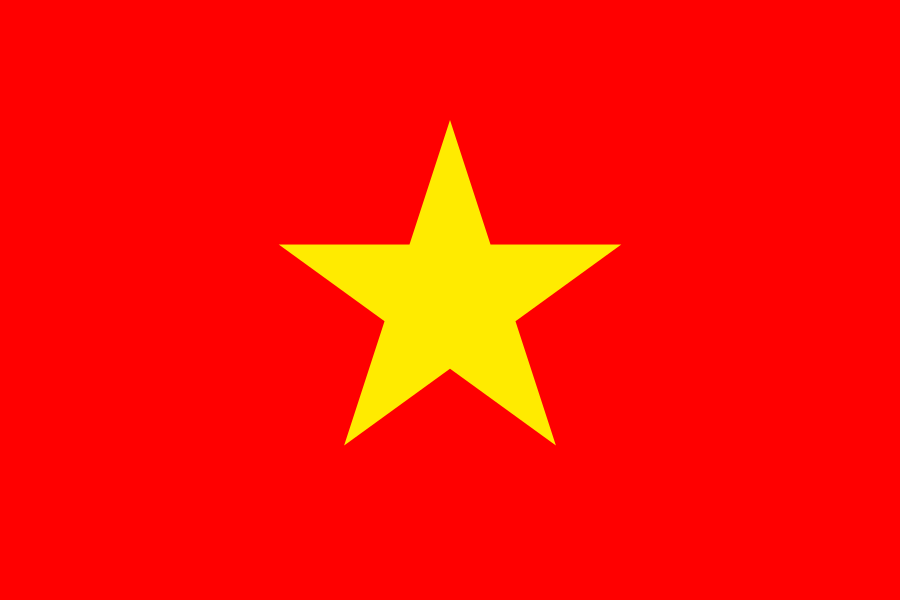
 Vietnam


Quick answerVietnam is a country in South-Eastern Asia, with a population of 102,300,000 (2025). Its capital is Hanoi, its official language is Vietnamese, and its currency is the Vietnamese đồng (VND). It covers 331,345 square kilometres (127,933 square miles), and its time zone is Asia/Ho_Chi_Minh.
Vietnam is a long, narrow country on the eastern edge of mainland South-East Asia, home to about 102 million people. Its capital is Hanoi, its official language is Vietnamese, and its currency is the đồng.
Key facts
| Capital | Hanoi |
|---|---|
| Population | 102,300,000 (2025) · 102.3 million |
| Population density | 329.9 people per km² (land area) |
| Area | 331,345 km² (127,933 sq mi) total · 310,070 km² (119,719 sq mi) land |
| Official language | Vietnamese (official) |
| Currency | Vietnamese đồng (VND, ₫) |
| Time zone | Asia/Ho_Chi_Minh |
| Government | Unitary communist state |
| Coastline | 3,444 km |
| Highest point | Fansipan, 3,143 m |
| Life expectancy | 74.7 years (2024) |
| Calling code | +84 |
| Driving side | Right |
| Internet domain | .vn |
Overview
Vietnam sits on the eastern edge of mainland South-East Asia, along the South China Sea, with China to the north and Laos and Cambodia to the west. It covers 331,345 square kilometres in a long, narrow S-shape, only about 50 kilometres across at its narrowest point, and its 3,444 kilometres of coastline run from the Red River Delta in the north to the Mekong Delta in the south. The highest point is Fansipan, at 3,143 metres in the northern highlands, and the country is mostly hilly and forested, with flat, crowded deltas at both ends.
About 102.3 million people lived in Vietnam in 2025, making it the 16th-most populous country in the world. Around 39 per cent of Vietnamese live in towns and cities, and the two big urban centres are Ho Chi Minh City in the south, with about 14 million people in the merged municipality, and the capital, Hanoi, with about 8.9 million. Vietnamese is the official language, and life expectancy at birth reached 74.7 years in 2024. Most people live in the two deltas, which grow the rice that feeds the country.
Vietnam is a unitary communist state, reunified in 1976 after decades of war. In 1986 it launched the Đổi Mới reforms, opening its economy to markets and foreign trade, and in the decades since it has become one of Asia's fastest-growing economies, built on manufacturing, farming and tourism. Vietnam is the world's second-largest exporter of coffee and the second-largest exporter of rice, and it is famous for Ha Long Bay, the old town of Hội An, and its food — above all phở and bánh mì. Its long history stretches back to the Bronze Age Đông Sơn culture, more than 2,000 years ago.
Vietnam's islands include Phú Quốc in the south and the Cát Bà archipelago in the north, and its old port town of Hội An, once a trading hub for Chinese, Japanese and European ships, is a UNESCO World Heritage site.
Notable facts
- Vietnam's population was 102,300,000 in 2025, making it the 16th-most populous country in the world.
- Vietnam is the world's second-largest exporter of coffee, after Brazil.
- Ha Long Bay, with its limestone islands rising from the sea, became a UNESCO World Heritage site in 1994.
- Vietnam launched the Đổi Mới ('renovation') economic reforms in 1986, opening the country to markets and foreign trade.
- Life expectancy at birth in Vietnam was 74.7 years in 2024, according to the World Bank.
How Vietnam compares
Comparison table — Vietnam next to 3 similar countries (neighbours first, then the same subregion).
| Country | Population | Area | Density | Capital |
|---|---|---|---|---|
| Vietnam ★ | 102,300,000 (2025) | 331,345 km² | 329.9 people per km² | Hanoi |
| China | 1,404,890,000 (2025) | 9,596,961 km² | 150.6 people per km² | Beijing |
| Indonesia | 290,125,073 (2026) | 1,904,569 km² | 160.2 people per km² | Jakarta |
| Thailand | 65,975,198 (2024) | 513,120 km² | 129.1 people per km² | Bangkok |
Cities in Vietnam
- Ho Chi Minh City 14,002,598 people (2025) Known for Independence Palace
- Hanoi 8,855,946 people (2025) · Capital Known for Temple of Literature
- Hai Phong 4,664,124 people (2025) Known for Port of Hai Phong
- Da Nang 3,856,400 people (2025) Known for Dragon Bridge
Frequently asked questions
What is the capital of Vietnam?
The capital of Vietnam is Hanoi. It is the country's second-largest city, with about 8.9 million people in the municipality (2025) and about 19.8 million in the metropolitan area. Hanoi sits on the Red River in northern Vietnam and is home to the Temple of Literature, Hoàn Kiếm Lake and the Imperial Citadel of Thăng Long.
What is the population of Vietnam?
Vietnam had a population of 102,300,000 in 2025, making it the 16th-most populous country in the world. About 39 per cent of Vietnamese live in towns and cities, with the largest urban areas around Ho Chi Minh City and Hanoi. Most people live in the Red River Delta in the north and the Mekong Delta in the south.
What language is spoken in Vietnam?
Vietnamese is the official language of Vietnam and is spoken by almost everyone in the country. It is written with the Latin alphabet, with marks for its six tones, a system introduced by European missionaries in the 17th century. Many people also speak English, and ethnic minority groups keep their own languages, such as Tày, Mường and Khmer.
What currency is used in Vietnam?
Vietnam uses the Vietnamese đồng (VND, symbol ₫). Banknotes come in denominations up to 500,000 đồng, and there are no coins in everyday use. Cash is still common in markets and small shops, but cards and mobile payments are widely accepted in hotels, restaurants and larger stores in the cities.
Where is Vietnam?
Vietnam is on the eastern edge of mainland South-East Asia, along the South China Sea. It borders China to the north, and Laos and Cambodia to the west. The country is long and narrow, stretching about 1,650 kilometres from the mountains of the north to the Mekong Delta in the south, with the sea along its whole eastern side.
What time zone is Vietnam in?
Vietnam uses a single time zone, Vietnam Standard Time (UTC+7), across the whole country. The IANA time zone name is Asia/Ho_Chi_Minh. There is no daylight saving time, so the clocks stay the same all year, from Hanoi in the north to Ho Chi Minh City and the Mekong Delta in the south.
Quick quiz
Three questions from the facts on this page. No sign-up, no score is saved.
Keep exploring
- Ho Chi Minh City — city in Vietnam
- Hanoi — capital of Vietnam
- Hai Phong — city in Vietnam
- Da Nang — city in Vietnam
- Cambodia — neighbouring country (page coming soon)
- China — neighbouring country
- Laos — neighbouring country (page coming soon)
- Indonesia — another country in South-Eastern Asia
- Thailand — another country in South-Eastern Asia
- All countries — the full list
Sources & last updated
- Wikipedia — Vietnam
- World Bank, World Development Indicators
- mledoze/countries (skeleton: area, borders, capital, languages, currency, demonym, calling code, landlocked, coordinates, region, tld)
- Wikipedia — List of countries and dependencies by length of coastline
- General Statistics Office of Viet Nam (GSO)
Last updated: . Figures are shown with their year; where sources disagree, the value is left out rather than estimated.