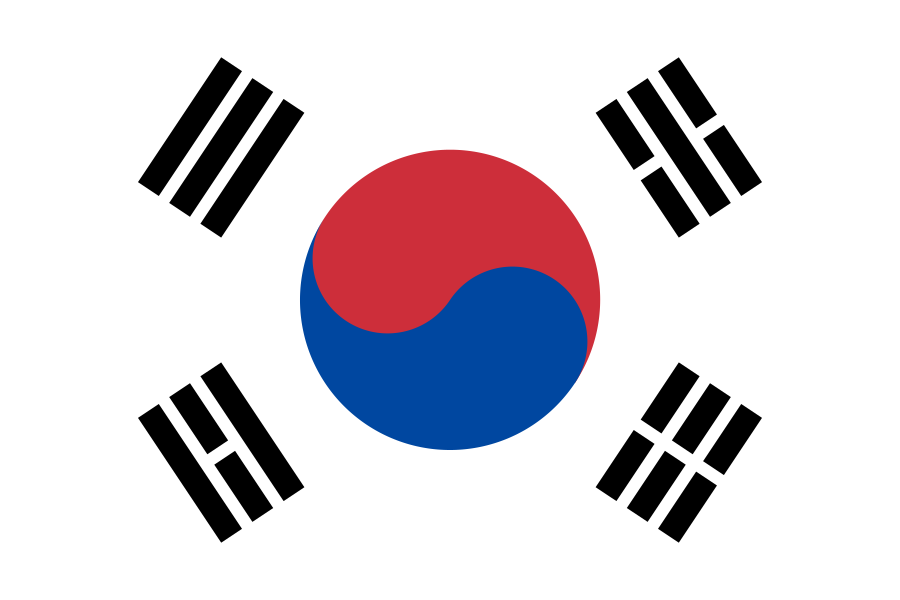
 South Korea


Quick answerSouth Korea is a country in Eastern Asia, with a population of 51,106,229 (2026). Its capital is Seoul, its official languages are Korean and Korean Sign Language, and its currency is the South Korean won (KRW). It covers 100,472 square kilometres (38,792 square miles), and its time zone is Asia/Seoul.
South Korea is a country in East Asia, home to about 51 million people. Its capital is Seoul, its official language is Korean, and its currency is the won.
Key facts
| Capital | Seoul |
|---|---|
| Population | 51,106,229 (2026) · 51.1 million |
| Population density | 527.3 people per km² (land area) |
| Area | 100,472 km² (38,792 sq mi) total · 96,920 km² (37,421 sq mi) land |
| Official languages | Korean (official), Korean Sign Language (official) |
| Currency | South Korean won (KRW, ₩) |
| Time zone | Asia/Seoul |
| Government | Unitary presidential republic |
| Coastline | 2,413 km |
| Highest point | Hallasan, 1,947 m |
| Life expectancy | 83.5 years (2024) |
| Calling code | +82 |
| Driving side | Right |
| Internet domain | .kr |
Overview
South Korea, officially the Republic of Korea, is a country in East Asia, covering the southern half of the Korean Peninsula and its nearby islands. It borders North Korea to the north along the Demilitarized Zone, with the Yellow Sea to the west and the Sea of Japan to the east. Mountains cover much of the country, and Hallasan, at 1,947 metres on the island of Jeju, is its highest point. The coastline runs for 2,413 kilometres. Jeju Island, South Korea's largest island, lies off the southern coast.
About 51.1 million people lived in South Korea in 2026, and about half of them live in the Seoul Capital Area, a metropolitan region of about 26 million people. Seoul, the capital, has about 9.6 million people, and Busan, Incheon and Daegu are the next largest cities. Busan is the largest port, and Incheon, next to Seoul, is home to the country's main international airport. Korean is the official language, written in the Hangul script, and life expectancy at birth was 83.5 years in 2024, among the highest in the world. About 81 per cent of South Koreans live in towns and cities.
South Korea is a unitary presidential republic. The peninsula's history runs from the Three Kingdoms through the Goryeo and Joseon dynasties to Japanese rule from 1910 to 1945, division after the Second World War, and the Korean War of 1950 to 1953. From the ruins of war, South Korea built one of the world's largest economies — worth about $2.2 trillion in 2026 by IMF estimate — and became a democracy in 1987. The country has 17 UNESCO World Heritage Sites, from the palaces of Seoul to the volcanic island of Jeju, and its music, television dramas and films, known as the Korean Wave, are popular around the world.
Notable facts
- About half of South Korea's population lives in the Seoul Capital Area, a metropolitan region of about 26 million people.
- South Korea had an estimated 51,106,229 people in 2026.
- Hallasan, at 1,947 metres on Jeju Island, is the highest point in South Korea.
- South Korea has 17 UNESCO World Heritage Sites, including the palaces of Seoul and the volcanic landscapes of Jeju Island.
- Life expectancy at birth in South Korea was 83.5 years in 2024, among the highest in the world.
How South Korea compares
Comparison table — South Korea next to 3 similar countries (neighbours first, then the same subregion).
| Country | Population | Area | Density | Capital |
|---|---|---|---|---|
| South Korea ★ | 51,106,229 (2026) | 100,472 km² | 527.3 people per km² | Seoul |
| China | 1,404,890,000 (2025) | 9,596,961 km² | 150.6 people per km² | Beijing |
| Japan | 122,950,000 (2026) | 377,975 km² | 337.3 people per km² | Tokyo |
| Australia | 27,801,023 (2025) | 7,692,024 km² | 3.6 people per km² | Canberra |
Cities in South Korea
See all 4 cities in South Korea →
- Seoul 9,579,449 people (2026) · Capital Known for Gyeongbokgung Palace
- Busan 3,285,147 people (2026) Known for Haeundae Beach
- Incheon 3,015,482 people (2026) Known for Incheon International Airport
- Daegu 2,351,461 people (2026) Known for Textiles and fashion
Frequently asked questions
What is the capital of South Korea?
The capital of South Korea is Seoul. It is also the country's largest city, with 9,579,449 people inside the city limits and about 26 million in the wider Seoul Capital Area (first quarter of 2026). Seoul sits on the Han River in the north-west of the country and is home to five grand palaces from the Joseon dynasty.
What is the population of South Korea?
South Korea had an estimated population of 51,106,229 in 2026. About half of all South Koreans live in the Seoul Capital Area, which makes Seoul one of the largest metropolitan areas in the world. The population is ageing fast, with one of the world's lowest birth rates.
What language is spoken in South Korea?
Korean is the official language of South Korea and is spoken by almost everyone in the country. It is written in Hangul, an alphabet created in the fifteenth century, and Korean Sign Language is also an official language. English is widely taught in schools.
What currency is used in South Korea?
South Korea uses the South Korean won (KRW, symbol ₩). The won is divided into 100 jeon, though jeon coins are no longer used in practice. Card payments are common almost everywhere, and cash is rarely needed in cities. Tipping is not expected.
Where is South Korea?
South Korea is in East Asia, on the southern half of the Korean Peninsula. It borders North Korea to the north along the Demilitarized Zone, with the Yellow Sea to the west and the Sea of Japan to the east. Japan lies across the sea to the south-east.
What time zone is South Korea in?
South Korea uses Korea Standard Time (KST, UTC+9) all year round and does not observe daylight saving time. The IANA time zone name is Asia/Seoul. South Korean time is nine hours ahead of Coordinated Universal Time, the same time as Japan.
Quick quiz
Three questions from the facts on this page. No sign-up, no score is saved.
Keep exploring
- Seoul — capital of South Korea
- Busan — city in South Korea
- Incheon — city in South Korea
- Daegu — city in South Korea
- North-korea — neighbouring country (page coming soon)
- China — another country in Eastern Asia
- Japan — another country in Eastern Asia
- All countries — the full list
Sources & last updated
- Wikipedia — South Korea
- CIA World Factbook — South Korea (archive mirror)
- World Bank, World Development Indicators
- mledoze/countries (skeleton: area, borders, capital, languages, currency, demonym, calling code, landlocked, coordinates, region, tld)
- UNESCO — South Korea
- Wikipedia — Hallasan
Last updated: . Figures are shown with their year; where sources disagree, the value is left out rather than estimated.