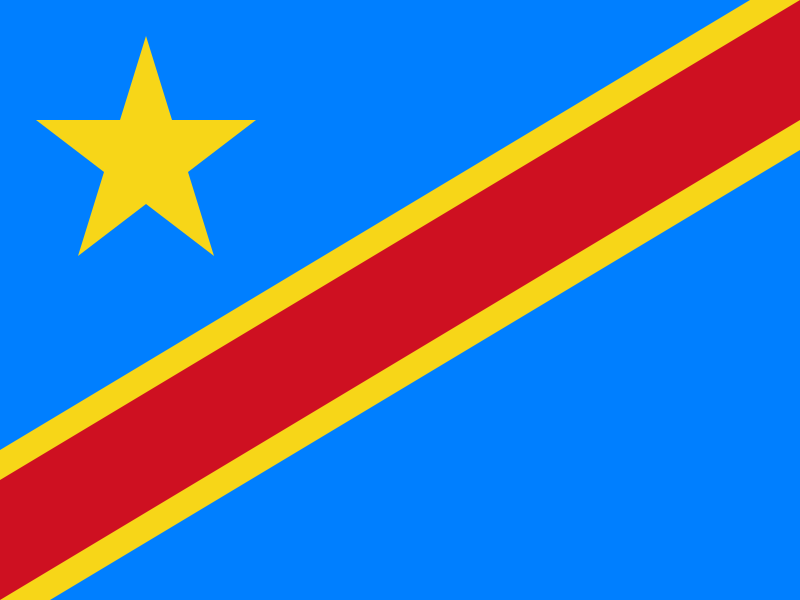
 Democratic Republic of the Congo
 – Virunga National Park (9).jpg?width=1200)

Quick answerDemocratic Republic of the Congo is a country in Middle Africa, with a population of 112,832,473 (2025). Its capital is Kinshasa, its official language is French, and its currency is the Congolese franc (CDF). It covers 2,345,409 square kilometres (905,567 square miles), and its time zone is Africa/Kinshasa.
The Democratic Republic of the Congo is a vast country in Central Africa, home to about 113 million people. Its capital is Kinshasa, its official language is French, and its currency is the Congolese franc.
Key facts
| Capital | Kinshasa |
|---|---|
| Population | 112,832,473 (2025) · 112.8 million |
| Population density | 49.8 people per km² (land area) |
| Area | 2,345,409 km² (905,567 sq mi) total · 2,267,050 km² (875,313 sq mi) land |
| Official languages | French (official), Kikongo, Lingala, Swahili, Tshiluba |
| Currency | Congolese franc (CDF, FC) |
| Time zones | Africa/Kinshasa, Africa/Lubumbashi |
| Government | Unitary semi-presidential republic |
| Coastline | 40 km |
| Highest point | Mount Stanley, 5,109 m |
| Life expectancy | 62.1 years (2024) |
| Calling code | +243 |
| Driving side | Right |
| Internet domain | .cd |
Overview
The Democratic Republic of the Congo covers 2,345,409 square kilometres in Central Africa, straddling the equator. It is the second-largest country in Africa after Algeria and the eleventh-largest in the world. Most of it lies in the Congo Basin, home to the world's second-largest tropical rainforest after the Amazon, crossed by the Congo River, the deepest river in the world. The east is mountainous, rising to Mount Stanley at 5,109 metres on the border with Uganda, while the west has only a short 40-kilometre strip of Atlantic coastline.
About 112.8 million people lived in the country in 2025, according to the World Bank, making it the fourth-most populous country in Africa and the most populous French-speaking country in the world. French is the official language, alongside four recognised national languages — Kikongo, Lingala, Swahili and Tshiluba — and more than 200 other languages are spoken. About 45 per cent of Congolese live in towns and cities, above all in Kinshasa, the capital. Life expectancy was 62.1 years in 2024, and the median age is only about 16.
The land was home to the Kingdom of Kongo and the Luba and Lunda empires before King Leopold II of Belgium took it as his personal Congo Free State in 1885. Belgium annexed it in 1908. Independence came in 1960, followed by the assassination of Prime Minister Patrice Lumumba and the long dictatorship of Mobutu Sese Seko. The Congo Wars of 1996 to 2003 killed millions, and armed groups remain active in the east. Félix Tshisekedi's election in 2019 brought the first peaceful transfer of power since independence.
The country is extraordinarily rich in minerals: raw minerals and metals made up 80 per cent of exports in 2023, with copper mined around Lubumbashi and diamonds around Mbuji-Mayi. Yet it remains one of the world's poorest countries, ranked 171st of 193 on the Human Development Index in 2023. Its wonders include Virunga National Park, Africa's oldest national park, founded in 1925 and home to mountain gorillas, and Salonga National Park. Kinshasa is the largest French-speaking city in the world and a powerhouse of Congolese rumba.
Notable facts
- The Democratic Republic of the Congo is the second-largest country in Africa and the eleventh-largest in the world, covering 2,345,409 square kilometres.
- With about 112.8 million people in 2025, the Democratic Republic of the Congo is the fourth-most populous country in Africa and the most populous French-speaking country in the world.
- The Congo River, which crosses the country, is the deepest river in the world.
- Raw minerals and metals accounted for 80 per cent of the Democratic Republic of the Congo's exports in 2023.
- Life expectancy at birth in the Democratic Republic of the Congo was 62.1 years in 2024, according to the World Bank.
How Democratic Republic of the Congo compares
Comparison table — Democratic Republic of the Congo next to 3 similar countries (neighbours first, then the same subregion).
| Country | Population | Area | Density | Capital |
|---|---|---|---|---|
| Democratic Republic of the Congo ★ | 112,832,473 (2025) | 2,345,409 km² | 49.8 people per km² | Kinshasa |
| Uganda | 45,905,417 (2024) | 241,038 km² | 232.9 people per km² | Kampala |
| Algeria | 47,435,312 (2025) | 2,381,741 km² | 19.9 people per km² | Algiers |
| Australia | 27,801,023 (2025) | 7,692,024 km² | 3.6 people per km² | Canberra |
Cities in Democratic Republic of the Congo
See all 4 cities in Democratic Republic of the Congo →
- Kinshasa Known for Largest French-speaking city in the world
- Mbuji-Mayi Known for Diamond mining
- Lubumbashi Known for Copper mining
- Kananga Known for Lulua River
Frequently asked questions
What is the capital of DR Congo?
The capital of the Democratic Republic of the Congo is Kinshasa, on the Congo River in the west of the country. It is also the largest city, with about 18.6 million people in the city-province (2021). Across the river sits Brazzaville, the capital of the neighbouring Republic of the Congo.
What is the population of DR Congo?
The Democratic Republic of the Congo had a population of about 112.8 million in 2025, according to the World Bank, making it the fourth-most populous country in Africa. It is also the most populous French-speaking country in the world, and about 45 per cent of its people live in towns and cities.
What language is spoken in DR Congo?
French is the official language of the Democratic Republic of the Congo and the language of government, schools and the media. Four national languages are also recognised: Kikongo, Lingala, Swahili and Tshiluba. Lingala is the most widely spoken of them, and more than 200 other languages are spoken across the country.
What currency is used in DR Congo?
The Democratic Republic of the Congo uses the Congolese franc (CDF, symbol FC). Banknotes are the usual form of the currency, and prices in shops and markets are given in francs. US dollars are also widely accepted in Kinshasa and in the mining towns of the south-east, especially for larger payments.
Where is DR Congo?
The Democratic Republic of the Congo sits in Central Africa, straddling the equator, and is the second-largest country in Africa after Algeria. It borders nine countries, including the Republic of the Congo, Angola, Zambia, Tanzania and Uganda, and has a short 40-kilometre stretch of Atlantic coastline in the west.
What time zone is DR Congo in?
The Democratic Republic of the Congo has two time zones. The west, including the capital Kinshasa, uses West Africa Time (UTC+1), with the IANA name Africa/Kinshasa. The east, including Lubumbashi, uses Central Africa Time (UTC+2), with the IANA name Africa/Lubumbashi. Neither zone uses daylight saving time.
Quick quiz
Three questions from the facts on this page. No sign-up, no score is saved.
Keep exploring
- Kinshasa — capital of Democratic Republic of the Congo
- Mbuji-Mayi — city in Democratic Republic of the Congo
- Lubumbashi — city in Democratic Republic of the Congo
- Kananga — city in Democratic Republic of the Congo
- Angola — neighbouring country (page coming soon)
- Burundi — neighbouring country (page coming soon)
- Central-african-republic — neighbouring country (page coming soon)
- Republic-of-congo — neighbouring country (page coming soon)
- Rwanda — neighbouring country (page coming soon)
- South-sudan — neighbouring country (page coming soon)
- Tanzania — neighbouring country (page coming soon)
- Uganda — neighbouring country
- Zambia — neighbouring country (page coming soon)
- All countries — the full list
Sources & last updated
- Wikipedia — Democratic Republic of the Congo
- World Bank, World Development Indicators
- world-countries (mledoze/countries: area, borders, capital, languages, currency, demonym, calling code, landlocked, coordinates, region, tld)
- Wikipedia — List of countries and dependencies by length of coastline
- Encyclopaedia Britannica — Democratic Republic of the Congo
Last updated: . Figures are shown with their year; where sources disagree, the value is left out rather than estimated.