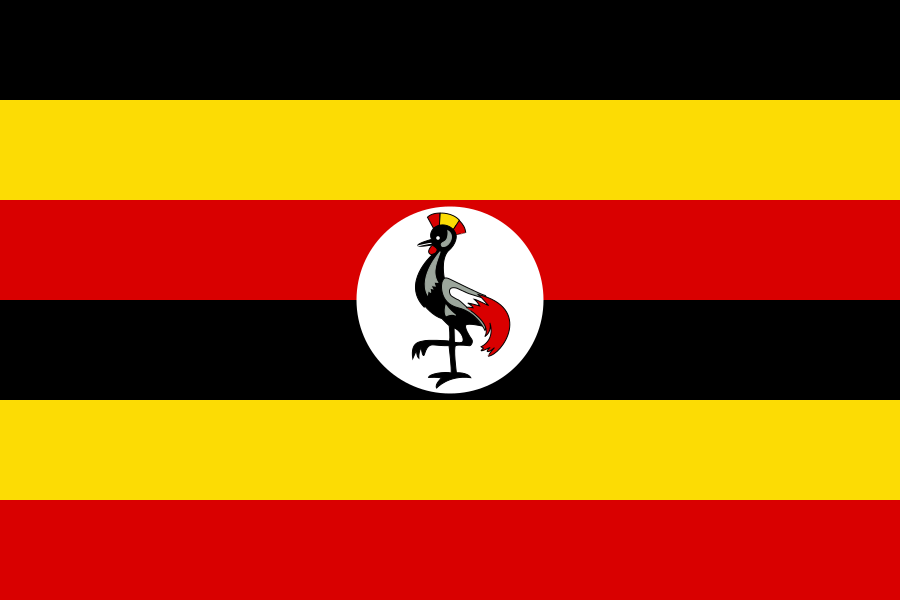
 Uganda


Quick answerUganda is a country in Eastern Africa, with a population of 45,905,417 (2024). Its capital is Kampala, its official languages are English and Swahili, and its currency is the Ugandan shilling (UGX). It covers 241,038 square kilometres (93,065 square miles), and its time zone is Africa/Kampala.
Uganda is a landlocked country in East Africa, home to about 46 million people. Its capital is Kampala, its official languages are English and Swahili, and its currency is the Ugandan shilling.
Key facts
| Capital | Kampala |
|---|---|
| Population | 45,905,417 (2024) · 45.9 million |
| Population density | 232.9 people per km² (land area) |
| Area | 241,038 km² (93,065 sq mi) total · 197,100 km² (76,101 sq mi) land |
| Official languages | English (official), Swahili (official) |
| Currency | Ugandan shilling (UGX, USh) |
| Time zone | Africa/Kampala |
| Government | Unitary presidential republic |
| Highest point | Mount Stanley, 5,109 m |
| Life expectancy | 68.5 years (2024) |
| Calling code | +256 |
| Driving side | Right |
| Internet domain | .ug |
Overview
Uganda is a landlocked country in East Africa, just north of the equator. It covers 241,038 square kilometres, with South Sudan to the north, Kenya to the east, Tanzania to the south, Rwanda to the south-west and DR Congo to the west. Lake Victoria, Africa's largest lake, lies along its southern edge, and the Nile leaves the lake at Jinja, beginning its long journey to the Mediterranean. The Rwenzori Mountains on the western border hold Mount Stanley, at 5,109 metres the highest point, and most of the country is a plateau about 1,000 to 1,200 metres above sea level.
The 2024 census counted 45,905,417 people, up from 34.6 million in 2014, an average growth rate of 2.9 per cent a year. About 32 per cent of Ugandans live in towns and cities, and the median age is 16.7 years, one of the youngest populations in the world. English is the official language, Swahili became the second official language in 2022, and Luganda is the most widely spoken local language. Life expectancy at birth was 68.5 years in 2024.
Uganda is named after the Buganda kingdom, which covers much of the south, including Kampala, and powerful kingdoms such as Kitara ruled the region long before Europeans arrived. Britain made Uganda a protectorate in 1894, and the country became independent on 9 October 1962. The decades that followed brought the rule of Idi Amin from 1971 to 1979, and Yoweri Museveni has led the country since 1986 under a presidential republic.
Winston Churchill called Uganda the Pearl of Africa, and its wildlife still draws visitors: about half of the world's mountain gorillas live in Bwindi Impenetrable Forest, and Murchison Falls, where the Nile squeezes through a narrow gorge, is the country's best-known sight. Uganda also hosts one of the largest refugee populations in Africa — the 2024 census counted 780,061 refugees — and coffee is its main export.
Notable facts
- Uganda's 2024 census counted 45,905,417 people, up from 34.6 million in 2014.
- The Nile begins in Uganda: its source is at Jinja, where the river leaves Lake Victoria, Africa's largest lake.
- About half of the world's mountain gorillas live in Uganda, in Bwindi Impenetrable Forest and Mgahinga.
- Uganda has one of the youngest populations in the world, with a median age of 16.7 years in 2024.
- The 2024 census counted 780,061 refugees living in Uganda, one of the largest refugee populations in Africa.
How Uganda compares
Comparison table — Uganda next to 3 similar countries (neighbours first, then the same subregion).
| Country | Population | Area | Density | Capital |
|---|---|---|---|---|
| Uganda ★ | 45,905,417 (2024) | 241,038 km² | 232.9 people per km² | Kampala |
| Democratic Republic of the Congo | 112,832,473 (2025) | 2,345,409 km² | 49.8 people per km² | Kinshasa |
| Kenya | 57,532,493 (2025) | 580,367 km² | 101.1 people per km² | Nairobi |
| Ethiopia | 135,472,051 (2025) | 1,104,300 km² | 123.5 people per km² | Addis Ababa |
Cities in Uganda
- Kampala Known for Seven hills
- Jinja Known for Source of the Nile
- Mbarara Known for Ankole long-horned cattle
- Lira Known for Lango culture
Frequently asked questions
What is the capital of Uganda?
The capital of Uganda is Kampala. It is also the country's largest city, with 1,797,722 people in the 2024 census, and it sits on seven hills near the northern shore of Lake Victoria. Kampala grew around the palace of the Kabaka, the king of Buganda, and became the capital at independence in 1962.
What is the population of Uganda?
Uganda had 45,905,417 people in the 2024 census, according to the Uganda Bureau of Statistics, up from 34.6 million in 2014. About 32 per cent of Ugandans live in towns and cities, and the median age is 16.7 years, one of the youngest populations in the world.
What language is spoken in Uganda?
English is the official language of Uganda, and Swahili became the second official language in 2022. Luganda, the language of the Buganda kingdom, is the most widely spoken local language, and more than 40 other languages are spoken across the country.
What currency is used in Uganda?
Uganda uses the Ugandan shilling (UGX, symbol USh). Banknotes come in denominations up to 50,000 shillings, and cash is still the norm in markets and small shops. Cards and mobile money work in hotels and larger businesses in Kampala, but carry cash outside the capital.
Where is Uganda?
Uganda is a landlocked country in East Africa, just north of the equator. It borders South Sudan to the north, Kenya to the east, Tanzania to the south, Rwanda to the south-west and DR Congo to the west. Lake Victoria, Africa's largest lake, lies along its southern edge.
What time zone is Uganda in?
Uganda uses a single time zone, East Africa Time (UTC+3), across the whole country. The IANA time zone name is Africa/Kampala. There is no daylight saving time, so the clocks stay the same all year, from Kampala on Lake Victoria to Gulu in the north.
Quick quiz
Three questions from the facts on this page. No sign-up, no score is saved.
Keep exploring
- Kampala — capital of Uganda
- Jinja — city in Uganda
- Mbarara — city in Uganda
- Lira — city in Uganda
- Democratic Republic of the Congo — neighbouring country
- Kenya — neighbouring country
- Rwanda — neighbouring country (page coming soon)
- South-sudan — neighbouring country (page coming soon)
- Tanzania — neighbouring country (page coming soon)
- Ethiopia — another country in Eastern Africa
- All countries — the full list
Sources & last updated
- Wikipedia — Uganda
- Uganda Bureau of Statistics — National Population and Housing Census 2024, Final Report Vol. 1 (Main)
- World Bank, World Development Indicators
- Wikipedia — List of countries and dependencies by area
- Wikipedia — List of highest points of African countries
Last updated: . Figures are shown with their year; where sources disagree, the value is left out rather than estimated.