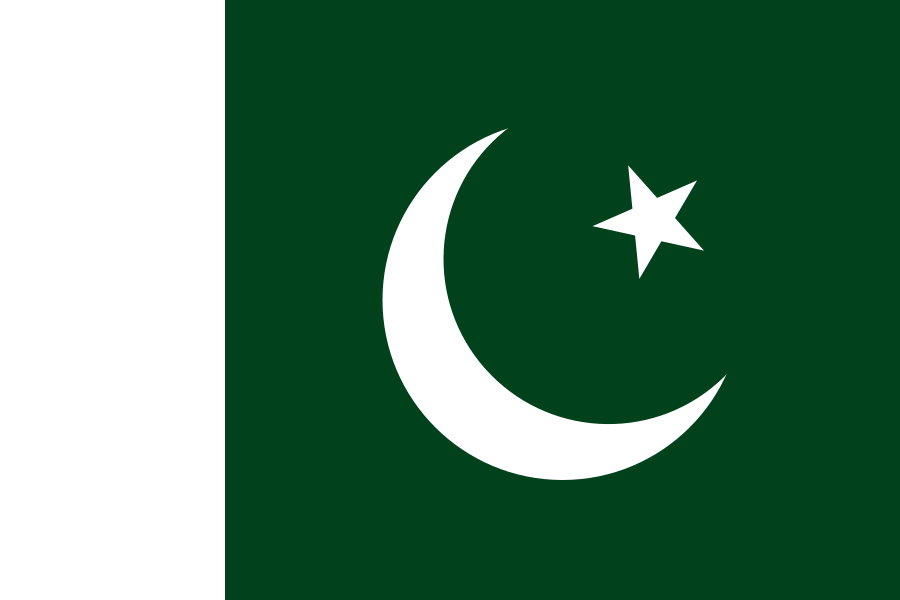
 Pakistan


Quick answerPakistan is a country in Southern Asia, with a population of 241,499,431 (2023). Its capital is Islamabad, its official languages are Urdu and English, and its currency is the Pakistani rupee (PKR). It covers 881,913 square kilometres (340,508 square miles), and its time zone is Asia/Karachi.
Pakistan is a country in South Asia, home to about 241 million people. Its capital is Islamabad, its largest city is Karachi, and its official languages are Urdu and English.
Key facts
| Capital | Islamabad |
|---|---|
| Population | 241,499,431 (2023) · 241.5 million |
| Population density | 313.3 people per km² (land area) |
| Area | 881,913 km² (340,508 sq mi) total · 770,875 km² (297,636 sq mi) land |
| Official languages | Urdu (official), English (official) |
| Currency | Pakistani rupee (PKR, ₨) |
| Time zone | Asia/Karachi |
| Government | Federal parliamentary Islamic republic |
| Coastline | 1,046 km |
| Highest point | K2, 8,611 m |
| Life expectancy | 67.7 years (2023) |
| Calling code | +92 |
| Driving side | Left |
| Internet domain | .pk |
Overview
Pakistan sits in South Asia, on the Arabian Sea, with India to the east, Afghanistan to the west, Iran to the south-west and China to the north-east. It covers 881,913 square kilometres, making it the 33rd-largest country in the world, and its 1,046 kilometres of coastline run along the Arabian Sea and the Gulf of Oman. The north is dominated by the Karakoram, Hindu Kush and Pamir ranges, home to five of the world's fourteen peaks over 8,000 metres, including K2 at 8,611 metres. The 1,609-kilometre Indus River runs the length of the country, watering the Punjab plains, while the Balochistan Plateau lies in the west and the Thar Desert in the east.
About 241.5 million people lived in Pakistan in the 2023 census, making it the fifth-most populous country in the world. Around 40 per cent of Pakistanis live in towns and cities, above all in Karachi, the largest city, with about 18.9 million people, and Lahore, with about 13 million. Urdu and English are the official languages, and life expectancy at birth was 67.7 years in 2023. Pakistan is a young country, with a median age of 22.9 years, and it has the world's second-largest Muslim population.
Pakistan is the site of some of the world's oldest civilisations, including the Neolithic site of Mehrgarh and the Indus Valley cities of Mohenjo-daro and Harappa, built around 2500 BCE. The region was later ruled by the Persians, the Greeks, the Mughals and the British, before Pakistan gained independence in 1947, when British India was partitioned. It is a federal parliamentary Islamic republic, and a declared nuclear-weapon state.
Today Pakistan's economy rests on farming, textiles and a growing service sector, and its culture is known for cricket, for the Mughal monuments of Lahore, and for the mountains of the north, which draw climbers and trekkers from around the world. Its cities range from the port metropolis of Karachi to the planned capital, Islamabad, built in the 1960s at the foot of the Margalla Hills.
Notable facts
- Pakistan's population was 241,499,431 in the 2023 census, making it the fifth-most populous country in the world.
- K2, on Pakistan's border with China, is the world's second-highest mountain at 8,611 metres, and Pakistan is home to five of the world's fourteen peaks over 8,000 metres.
- Mohenjo-daro, one of the great cities of the Indus Valley Civilisation, was built around 2500 BCE and is a UNESCO World Heritage site.
- Pakistan has the world's second-largest Muslim population, after Indonesia.
- The Indus River runs about 1,609 kilometres from the mountains of the north to the Arabian Sea.
How Pakistan compares
Comparison table — Pakistan next to 3 similar countries (neighbours first, then the same subregion).
| Country | Population | Area | Density | Capital |
|---|---|---|---|---|
| Pakistan ★ | 241,499,431 (2023) | 881,913 km² | 313.3 people per km² | Islamabad |
| China | 1,404,890,000 (2025) | 9,596,961 km² | 150.6 people per km² | Beijing |
| India | 1,464,000,000 (2025) | 3,287,263 km² | 492.4 people per km² | New Delhi |
| Iran | 92,417,681 (2025) | 1,648,195 km² | 56.7 people per km² | Tehran |
Cities in Pakistan
See all 4 cities in Pakistan →
- Karachi Known for Mazar-e-Quaid
- Lahore Known for Badshahi Mosque
- Faisalabad Known for Clock Tower (Ghanta Ghar)
- Islamabad Known for Faisal Mosque
Frequently asked questions
What is the capital of Pakistan?
The capital of Pakistan is Islamabad. It is a planned city built in the 1960s at the foot of the Margalla Hills, with about 1.1 million people in the city itself and about 2.4 million in the Capital Territory. Islamabad replaced Karachi as the national capital in 1967, and it is home to the Faisal Mosque and the Pakistan Monument.
What is the population of Pakistan?
Pakistan had a population of 241,499,431 in the 2023 census, making it the fifth-most populous country in the world. About 40 per cent of Pakistanis live in towns and cities, above all in Karachi and Lahore. The United Nations estimates the population has since risen to about 250 million, so the census figure is already a few years old.
What language is spoken in Pakistan?
Urdu and English are the official languages of Pakistan. Urdu is the national language and the language of government, schools and television, while English is used in law, business and higher education. Most Pakistanis speak another language at home, above all Punjabi, Pashto, Sindhi, Saraiki and Balochi.
What currency is used in Pakistan?
Pakistan uses the Pakistani rupee (PKR, symbol ₨). Banknotes come in denominations up to 5,000 rupees, and coins are rarely used for everyday shopping. Cash is still common in bazaars and small shops, but cards and mobile wallets are widely accepted in hotels, restaurants and larger stores in the cities.
Where is Pakistan?
Pakistan is in South Asia, on the Arabian Sea. It borders India to the east, Afghanistan to the west, Iran to the south-west and China to the north-east. The country stretches from the high Karakoram mountains in the north, home to K2, down the Indus River plain to the Arabian Sea coast in the south.
What time zone is Pakistan in?
Pakistan uses a single time zone, Pakistan Standard Time (UTC+5), across the whole country. The IANA time zone name is Asia/Karachi. There is no daylight saving time, so the clocks stay the same all year, from the mountains of Gilgit-Baltistan in the north to Karachi on the Arabian Sea coast.
Quick quiz
Three questions from the facts on this page. No sign-up, no score is saved.
Keep exploring
- Karachi — city in Pakistan
- Lahore — city in Pakistan
- Faisalabad — city in Pakistan
- Islamabad — capital of Pakistan
- Afghanistan — neighbouring country (page coming soon)
- China — neighbouring country
- India — neighbouring country
- Iran — neighbouring country
- Bangladesh — another country in Southern Asia
- All countries — the full list
Sources & last updated
- Wikipedia — Pakistan
- United Nations, World Population Prospects 2024 (via Wikipedia — List of countries by population)
- Wikipedia — List of countries and dependencies by length of coastline (CIA World Factbook figures)
- Wikipedia — List of countries by median age (CIA World Factbook 2024 estimates)
- Wikipedia — List of countries by life expectancy (United Nations, 2023 estimates)
- World Bank, World Development Indicators (urban population % SP.URB.TOTL.IN.ZS)
- mledoze/countries (skeleton: borders, capital, languages, tld, coordinates, subregion)
Last updated: . Figures are shown with their year; where sources disagree, the value is left out rather than estimated.