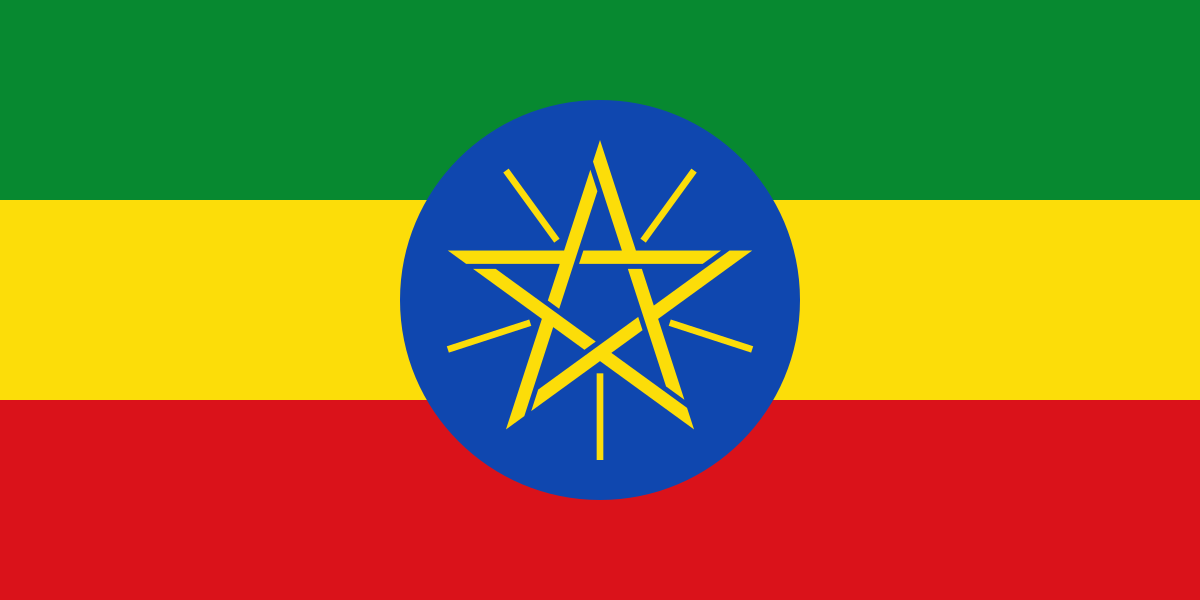
 Ethiopia


Quick answerEthiopia is a country in Eastern Africa, with a population of 135,472,051 (2025). Its capital is Addis Ababa, its official languages include Afar, Amharic and 3 others, and its currency is the Ethiopian birr (ETB). It covers 1,104,300 square kilometres (426,372 square miles), and its time zone is Africa/Addis_Ababa.
Ethiopia is a landlocked country in the Horn of Africa, home to about 135 million people. Its capital is Addis Ababa, its working language is Amharic, and its currency is the birr.
Key facts
| Capital | Addis Ababa |
|---|---|
| Population | 135,472,051 (2025) · 135.5 million |
| Population density | 123.5 people per km² (land area) |
| Area | 1,104,300 km² (426,372 sq mi) total · 1,096,570 km² (423,388 sq mi) land |
| Official languages | Afar (official), Amharic (official), Oromo (official), Somali (official), Tigrinya (official) |
| Currency | Ethiopian birr (ETB, Br) |
| Time zone | Africa/Addis_Ababa |
| Government | Federal parliamentary republic |
| Highest point | Ras Dashen, 4,550 m |
| Life expectancy | 67.6 years (2024) |
| Calling code | +251 |
| Driving side | Right |
| Internet domain | .et |
Overview
Ethiopia is a landlocked country in the Horn of Africa, in East Africa. It covers 1,104,300 square kilometres, with Eritrea to the north, Djibouti to the north-east, Somalia to the south-east, Kenya to the south, and South Sudan and Sudan to the west. Most of the country is highland: Ras Dashen, at 4,550 metres in the Simien Mountains, is the highest point, and the Great Rift Valley splits the plateau from north-east to south-west. The Blue Nile rises at Lake Tana in the north-west, while the Danakil Depression in the north-east is one of the hottest places on Earth.
About 135.5 million people lived in Ethiopia in 2025, making it the second-most populous country in Africa, after Nigeria. Only about 24 per cent of Ethiopians live in towns and cities, and the median age is 18.9 years. More than 80 languages are spoken; Amharic is the working language of the federal government, alongside Afar, Oromo, Somali and Tigrinya. Most Ethiopians are Orthodox Christians or Muslims, and life expectancy at birth was 67.6 years in 2024.
Ethiopia is one of the oldest inhabited places on Earth: anatomically modern humans emerged here, and the 3.2-million-year-old skeleton known as Lucy was found in the Afar in 1974. The Kingdom of Aksum ruled the region for centuries, Christianity arrived in the 4th century, and the rock-hewn churches of Lalibela were cut in the 12th and 13th centuries. Ethiopia defeated Italy at the Battle of Adwa in 1896 and stayed independent through the Scramble for Africa, though Italy occupied it from 1936 to 1941. A federal republic since 1995, it is now governed under a constitution adopted that year.
Ethiopia is the home of coffee: Coffea arabica grows wild in the forests of the south-west, around Kaffa, and the coffee ceremony is a daily ritual across the country. It keeps its own calendar of thirteen months, about seven to eight years behind the Gregorian one. Its twelve UNESCO World Heritage sites include Lalibela, the Simien Mountains and Aksum, and the capital, Addis Ababa, hosts the headquarters of the African Union.
Notable facts
- Ethiopia had 135,472,051 people in 2025, making it the second-most populous country in Africa, after Nigeria.
- Coffee comes from Ethiopia: Coffea arabica grows wild in the forests of the south-west, around Kaffa, and every arabica plant in the world traces back to them.
- Ethiopia defeated Italy at the Battle of Adwa in 1896 and stayed independent through the Scramble for Africa, one of only two African countries never colonised.
- The rock-hewn churches of Lalibela, cut downward into solid rock in the 12th and 13th centuries, became a UNESCO World Heritage site in 1978.
- Ethiopia follows its own calendar of thirteen months — twelve of 30 days plus a short month of five or six days — about seven to eight years behind the Gregorian calendar.
How Ethiopia compares
Comparison table — Ethiopia next to 3 similar countries (neighbours first, then the same subregion).
| Country | Population | Area | Density | Capital |
|---|---|---|---|---|
| Ethiopia ★ | 135,472,051 (2025) | 1,104,300 km² | 123.5 people per km² | Addis Ababa |
| Kenya | 57,532,493 (2025) | 580,367 km² | 101.1 people per km² | Nairobi |
| Uganda | 45,905,417 (2024) | 241,038 km² | 232.9 people per km² | Kampala |
| Algeria | 47,435,312 (2025) | 2,381,741 km² | 19.9 people per km² | Algiers |
Cities in Ethiopia
See all 4 cities in Ethiopia →
- Addis Ababa Known for African Union headquarters
- Dire Dawa Known for Railway heritage
- Mekelle Known for Hawelti Martyrs' Memorial
- Adama Known for Sodere hot springs
Frequently asked questions
What is the capital of Ethiopia?
The capital of Ethiopia is Addis Ababa. It is also the country's largest city, with about 6.3 million people in 2025, and it hosts the headquarters of the African Union. The city was founded in 1886 by Emperor Menelik II and stands 2,355 metres above sea level, the highest capital in Africa.
What is the population of Ethiopia?
Ethiopia had 135,472,051 people in 2025, according to the World Bank, making it the second-most populous country in Africa, after Nigeria. Only about 24 per cent of Ethiopians live in towns and cities, and the median age is 18.9 years, one of the youngest populations in the world.
What language is spoken in Ethiopia?
Amharic is the working language of Ethiopia's federal government, alongside Afar, Oromo, Somali and Tigrinya, which became federal working languages in 2020. More than 80 languages are spoken across the country, and English is widely used in schools and business.
What currency is used in Ethiopia?
Ethiopia uses the birr (ETB, symbol Br). Banknotes come in denominations up to 200 birr, and cash is still the norm in markets and small shops. Cards work in larger hotels and restaurants in Addis Ababa, but carry cash when travelling outside the capital.
Where is Ethiopia?
Ethiopia is a landlocked country in the Horn of Africa, in East Africa. It borders Eritrea to the north, Djibouti to the north-east, Somalia to the south-east, Kenya to the south, and South Sudan and Sudan to the west. The country covers 1,104,300 square kilometres of highlands and rift valley.
What time zone is Ethiopia in?
Ethiopia uses a single time zone, East Africa Time (UTC+3), across the whole country. The IANA time zone name is Africa/Addis_Ababa. There is no daylight saving time. Ethiopia also keeps its own clock, which counts the hours from dawn, so 7 o'clock in the morning is 1 o'clock locally.
Quick quiz
Three questions from the facts on this page. No sign-up, no score is saved.
Keep exploring
- Addis Ababa — capital of Ethiopia
- Dire Dawa — city in Ethiopia
- Mekelle — city in Ethiopia
- Adama — city in Ethiopia
- Djibouti — neighbouring country (page coming soon)
- Eritrea — neighbouring country (page coming soon)
- Kenya — neighbouring country
- Somalia — neighbouring country (page coming soon)
- South-sudan — neighbouring country (page coming soon)
- Sudan — neighbouring country (page coming soon)
- Uganda — another country in Eastern Africa
- All countries — the full list
Sources & last updated
- Wikipedia — Ethiopia
- World Bank, World Development Indicators
- Wikipedia — List of countries and dependencies by area
- Wikipedia — List of highest points of African countries
- UNESCO — Rock-Hewn Churches, Lalibela
Last updated: . Figures are shown with their year; where sources disagree, the value is left out rather than estimated.